
If a perfume bottle is opened in a corner of a room, it takes a long time before the aromatic gas substance can be detected at the opposite corner of the room. This experiment appears to contradict the mean gas velocity described in the previous chapter. The reason for this is that gas particles undergo numerous collisions during their flight. The mean free path is the average distance a particle can travel between two consecutive collisions with other particles.
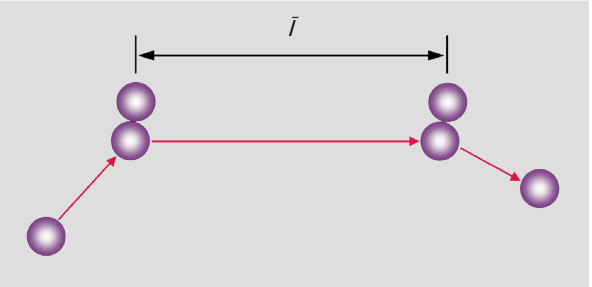
Figure : Mean free path between two collisions For collisions between particles of the same type, the mean free path is calculated by the following formula:

Formula : Mean Free Path
| j | mean free path | [m] |
| dm | molecular diameter | [m] |
The formula shows that the mean free path is proportional to temperature and inversely proportional to pressure and molecular diameter. At this point, we will ignore further variants of this equation discussed in academic literature, which examines collisions between gas particles of different diameters, collisions between gas particles and ions or electrons, and temperature effects.
To illustrate the temperature dependence of the mean free path, Formula 1-11 is often written with temperature as the only variable on the right side of the equation.

Formula : Mean Free Path II
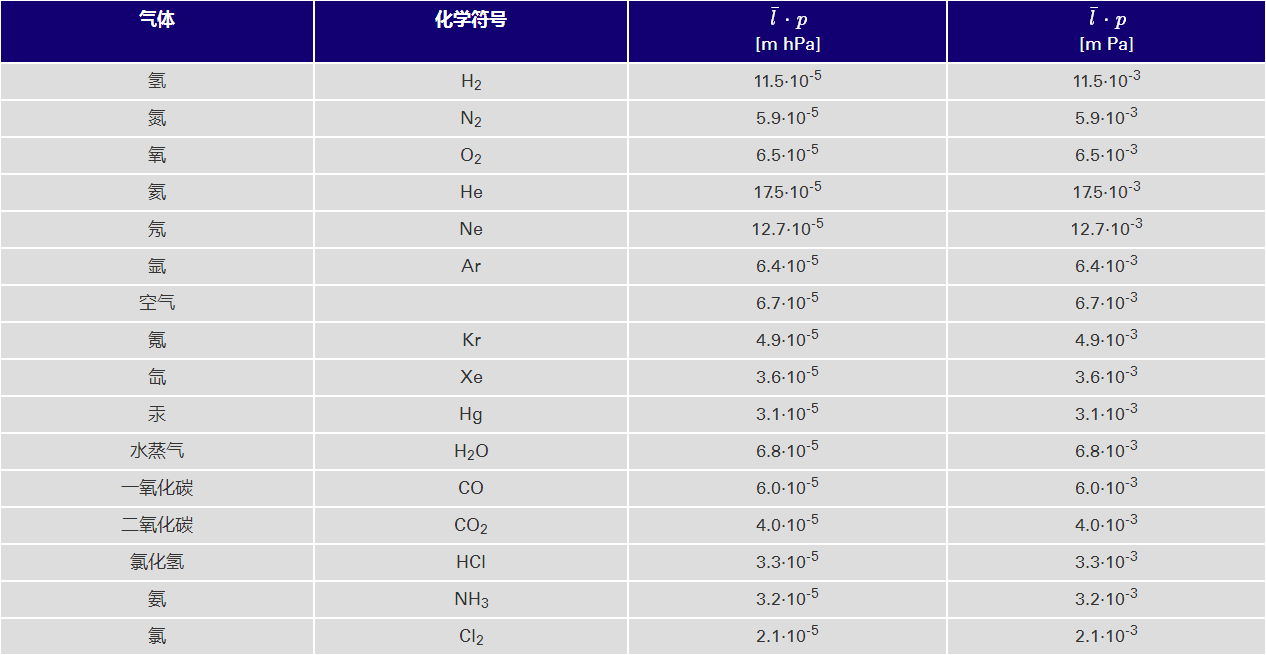
Table : Mean free path of gases at 273.15 K, showing j⋅p values for some gases at 0°C
Using the values in the table, we now estimate the mean free path of nitrogen molecules at various pressures:
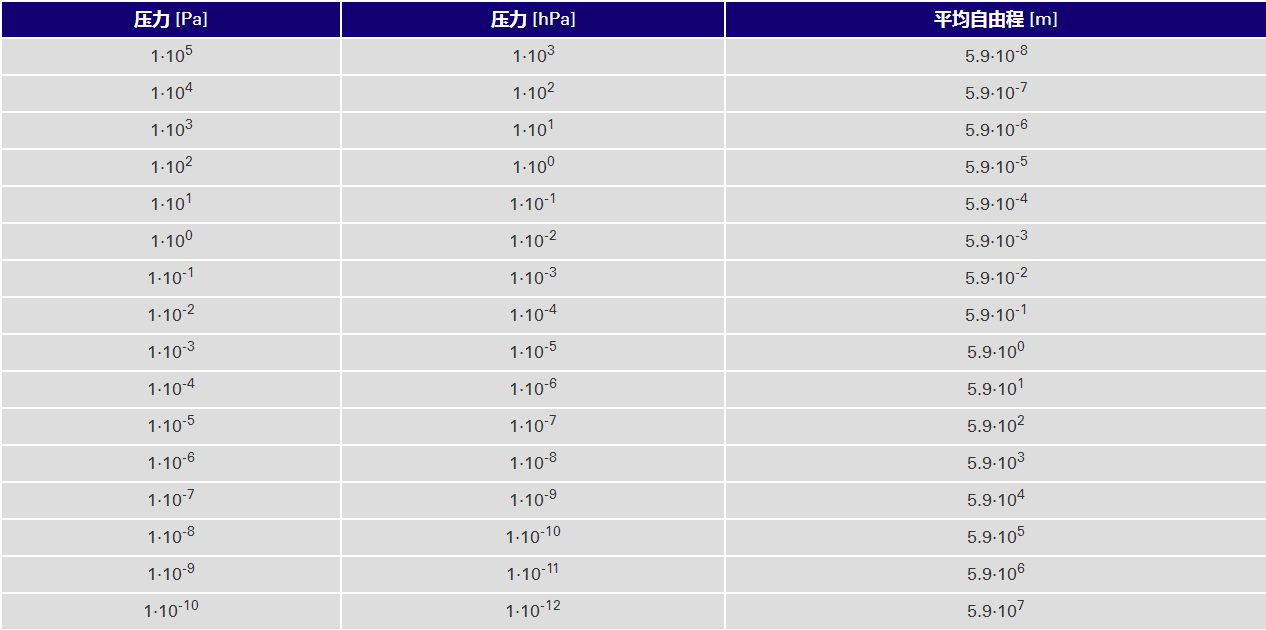
At atmospheric pressure, the distance nitrogen molecules travel between two collisions is 59 nm, while under ultra-high vacuum at pressures below 10-8 hPa, the distance traveled is several kilometers.The relationship between molecular number density and mean free path can be represented in a graph.
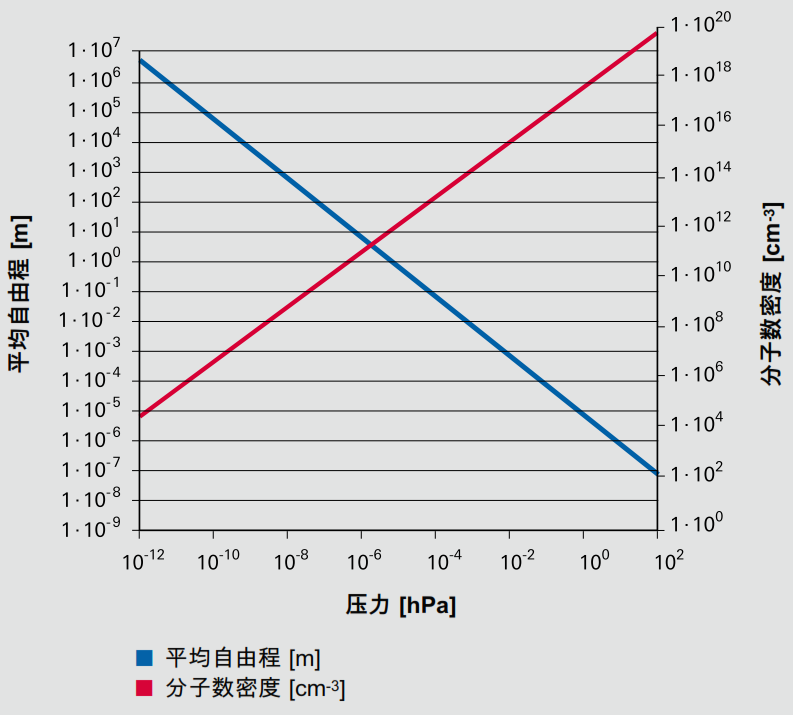
Figure: Molecular number density of nitrogen at 273.15 K (red, right y-axis) and mean free path (blue, left y-axis)