



Operating Principle of Dry-Running Rotary Vane Vacuum Pump
Increasing pressure by reducing volume is the principle of rotary vane operation. This design provides excellent performance in pressure, vacuum, or a combination of both.
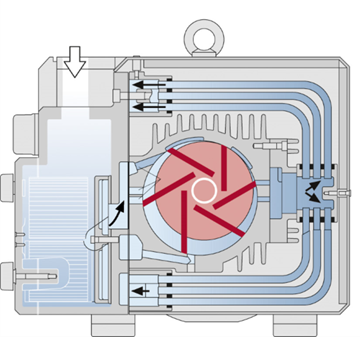
In a cylindrical housing, the rotor is positioned eccentrically so that its top almost touches the cylinder. The so-called rotor blades or vanes are located in the rotor slots.
When the rotor starts turning, centrifugal force throws the vanes outward and they slide along the inner surface of the cylinder. In this way, a cell is formed between two vanes, and its volume changes continuously during rotation.
Air enters a cell from the intake port until the trailing vane reaches the far end of the intake port. At this point, the cell has reached its maximum air volume. As the cell moves away from the port, its volume becomes smaller and smaller, so the air is compressed and the pressure rises.
This continues until the pressure in the cell exceeds the pressure in the pressure chamber, and the compressed air is then discharged through the outlet port.
Some models are equipped with an exhaust valve that prevents discharged air from flowing back if maximum pressure is reached. In a vacuum pump, the process is similar, but the pressure in the cell decreases while the chamber is at atmospheric pressure.
For pressure vacuum pumps, the lower end of the vacuum inlet is moved forward. The cell can now be filled through a second inlet. To avoid weakening the vacuum, the second inlet is located about one cell segment away from the main suction inlet. The ratio between vacuum and pressure capacity is affected by the choice of inlet ports.
PDF
Product document preview
Paging, zoom and full screen · original PDF available
Loading PDF…
PDF
Product document preview
Paging, zoom and full screen · original PDF available
Loading PDF…
PDF
Product document preview
Paging, zoom and full screen · original PDF available
Loading PDF…


 Pre sales customer service
