


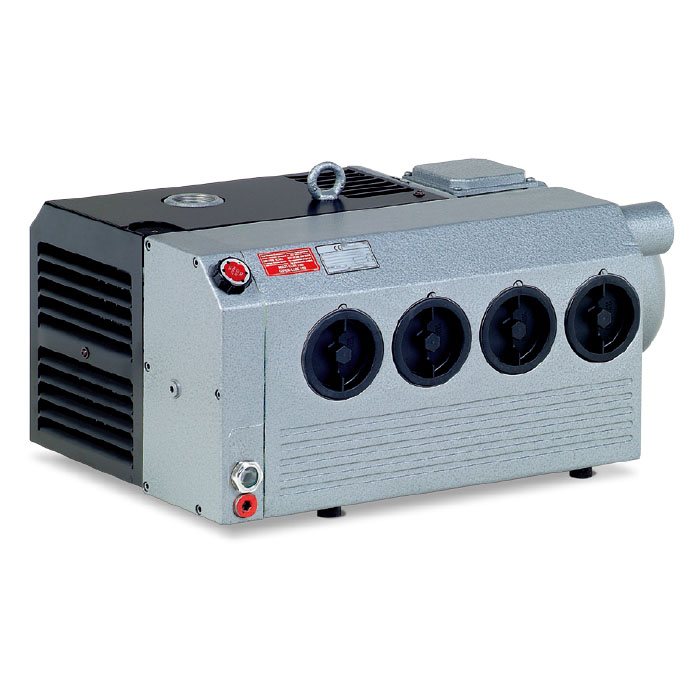

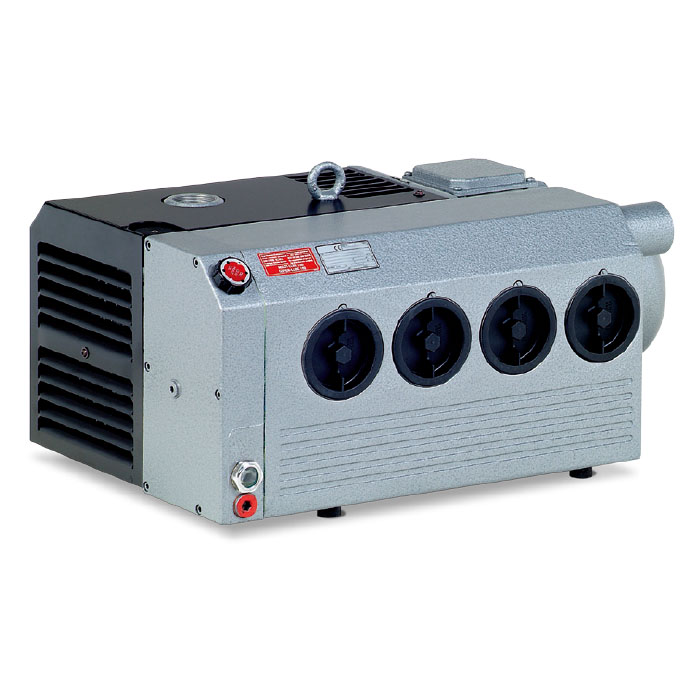
Oil-lubricated rotary vane pump V-VC
Oil-immersed rotary vane vacuum pump
Flange-mounted motor.
Bearings on both sides of the rotor.
The oil/air heat exchanger is standard.
Size 150 and larger are equipped with a fine mesh filter, vacuum non-return valve, gas ballast valve, protective cover and oil separator as standard.
IV version for industrial vacuum
The XD version is suitable for heavy-duty applications with wet and humid processes.
How oil-lubricated rotary vane vacuum pumps work
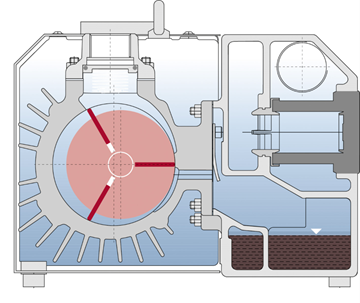
Increasing pressure by reducing volume is the principle behind rotary vane operation. This design provides excellent service for pressure, vacuum or a combination of both. In a cylindrical housing, the rotor is positioned eccentrically so that its top almost touches the cylinder. The so-called rotor blades or vanes sit in slots in the rotor. For example, when the rotor starts turning, centrifugal force throws the vanes out and they slide along the inner surface of the cylinder.
In this way, a cell is formed between two vanes, and its volume changes continuously during rotation. Air enters a cell from the inlet until the trailing vane reaches the far end of the inlet. At this point the cell has reached its maximum volume.
As the cell moves away from the port, its volume becomes smaller and smaller, so the air is compressed and the pressure rises. Some models have a discharge valve next to the outlet that prevents discharged air from flowing back when maximum pressure is reached.
PDF
Product document preview
Paging, zoom and full screen · original PDF available
Loading PDF…
PDF
Product document preview
Paging, zoom and full screen · original PDF available
Loading PDF…
PDF
Product document preview
Paging, zoom and full screen · original PDF available
Loading PDF…

 Pre sales customer service
