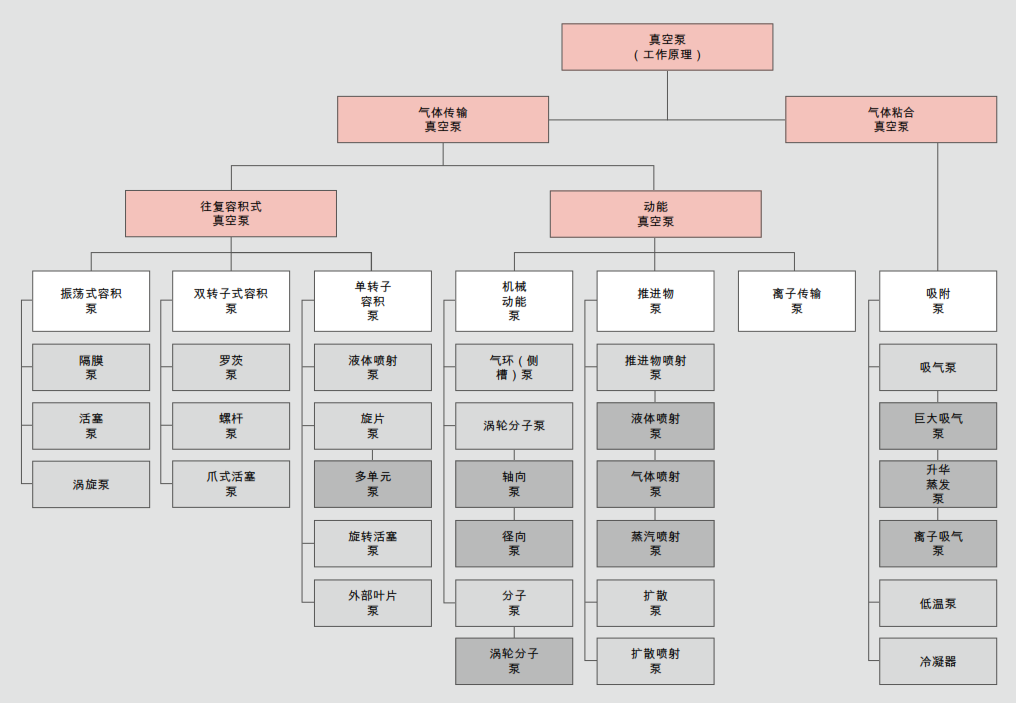
Vacuum pumps are divided into gas transfer pumps and gas adsorption or capture pumps. Gas transfer vacuum pumps can be used continuously, while gas adsorption vacuum pumps have a limited gas absorption capacity and must be regenerated at specific process intervals.
Gas transfer pumps are divided into positive displacement vacuum pumps and momentum transfer vacuum pumps. Positive displacement pumps discharge gas from a sealed space to the atmosphere or to a backing pump. Momentum transfer pumps draw gas out by accelerating it in the direction of motion through mechanical drive or a steam jet. Gas adsorption vacuum pumps adsorb gas onto a special active surface by gettering or by condensing the gas at a suitable temperature. Adsorption pumps continuously produce a clean getter surface through evaporation and/or sublimation or sputtering. If the gas particles to be pumped are ionized in an ion pump before interacting with the getter surface, they are buried by the sputtered material while the getter surface is cleaned by sputtering. Non-evaporable getters (NEG) consist of highly reactive alloys, mainly composed of zirconium or titanium, and have a very large specific surface area. Gas can permeate through micropores deep into the getter material and combine there into stable compounds.