
Pressure is defined as the ratio of the force acting perpendicularly and uniformly on a surface to the surface area.

| P | Pressure | [Pa] | |
| F | Force | [N];1 N = 1 kg m s-2 | |
| A | Area | [m2] |
Pressure definition
In a closed container, gas particles are in continuous thermal motion. In their interaction with the container walls, atoms and molecules undergo numerous collisions. Each collision exerts a force on the container wall. If the enclosed gas is not affected by external influences, the pressure generated by countless collisions is the same wherever and in whatever direction it is measured inside the container.
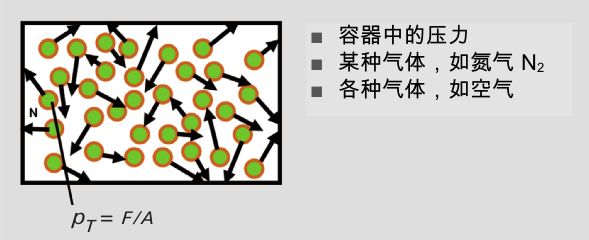
Definition of total pressure
In practice, a single gas is very rare. Mixtures of different gases are more common. Each individual component of these gases generates a corresponding pressure that can be measured independently of the other components. The pressure generated by a single component gas is called partial pressure. In an ideal gas, the partial pressures of the components add up to the total pressure without interfering with one another. The sum of all partial pressures equals the total pressure of the gas mixture.
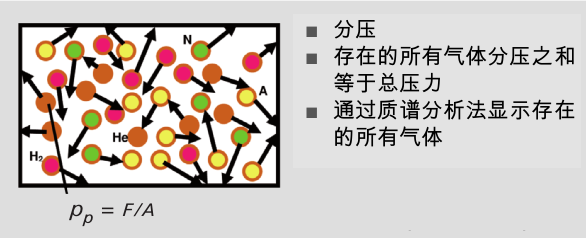
Definition of partial pressure
Ambient air is an example of a gas mixture: its partial pressure composition is shown in the table.
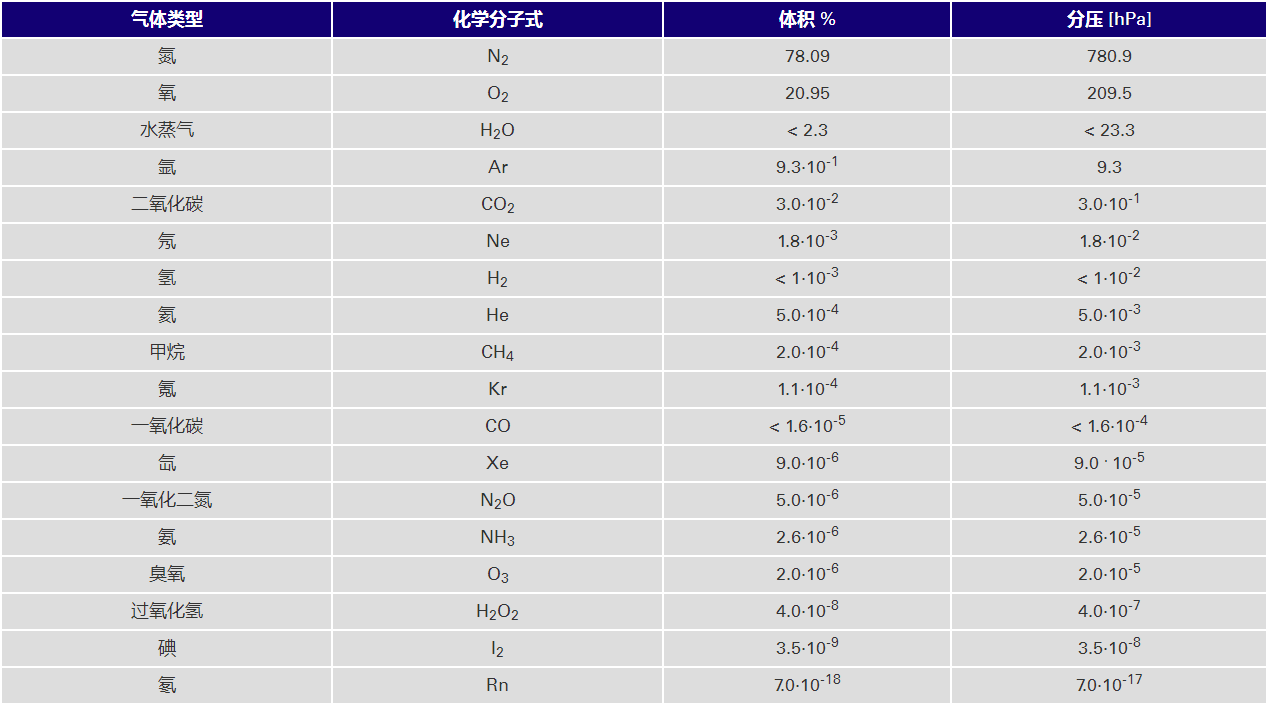
Figure : Composition of the atmosphere. The partial pressures shown are those at an atmospheric pressure of 1,000 hPa. Note: the value indicated for water vapor is the saturated state at 293 K (20°C). Fluctuations in carbon dioxide and carbon monoxide values depend on time and location. The carbon monoxide shown is a peak value in large cities. Other sources refer to a natural hydrogen concentration of 5 · 10< span style="box-sizing: border-box;line-height: 0;position: relative;vertical-align: baseline;top: -0.5em;color: rgb(51, 51, 51);font-family: ">-5% and a partial pressure of 5 · 10-4 hPa.

Figure : Pressure ranges in vacuum technology
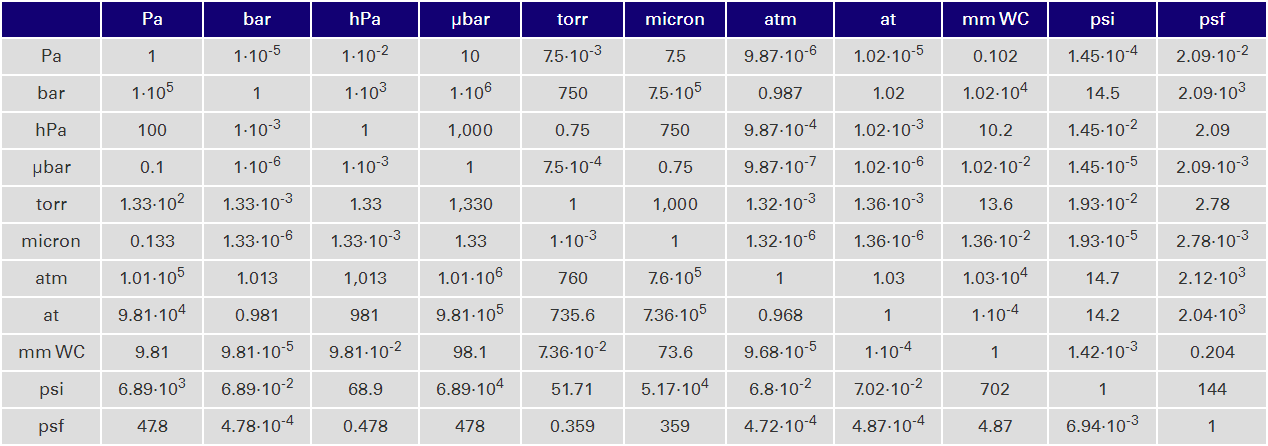
Fig. 1.3: Pressure unit conversion table
In outer space, depending on the proximity to galaxies, pressures below 10-18 hPa dominate. On Earth, technically generated pressures below 10-16 hPa have been reported. The pressure range down to 10-16 hPa covers 19 orders of magnitude. Depending on the vacuum levels achievable by different vacuum generation and measurement equipment, we have further classified the vacuum ranges by vacuum level, as shown in Table 1.2.
The unit of pressure measurement is the pascal. It is named after the French mathematician, physicist, writer, and philosopher Blaise Pascal (1623 – 1662). According to Formula 1-3, the SI unit pascal is composed of Pa = N m-2 . The units mbar, torr, and those shown in Table 1.3 are common in practical use.